PRISM EQ - N73 User Manual
1. Introduction
PRISM EQ - N73 is a VST3 effect inspired by a British Class A console. It combines a three-band equalizer with a high-pass filter. Shape the sound with stepped frequency selectors and use DRIVE to adjust the character of the input stage.
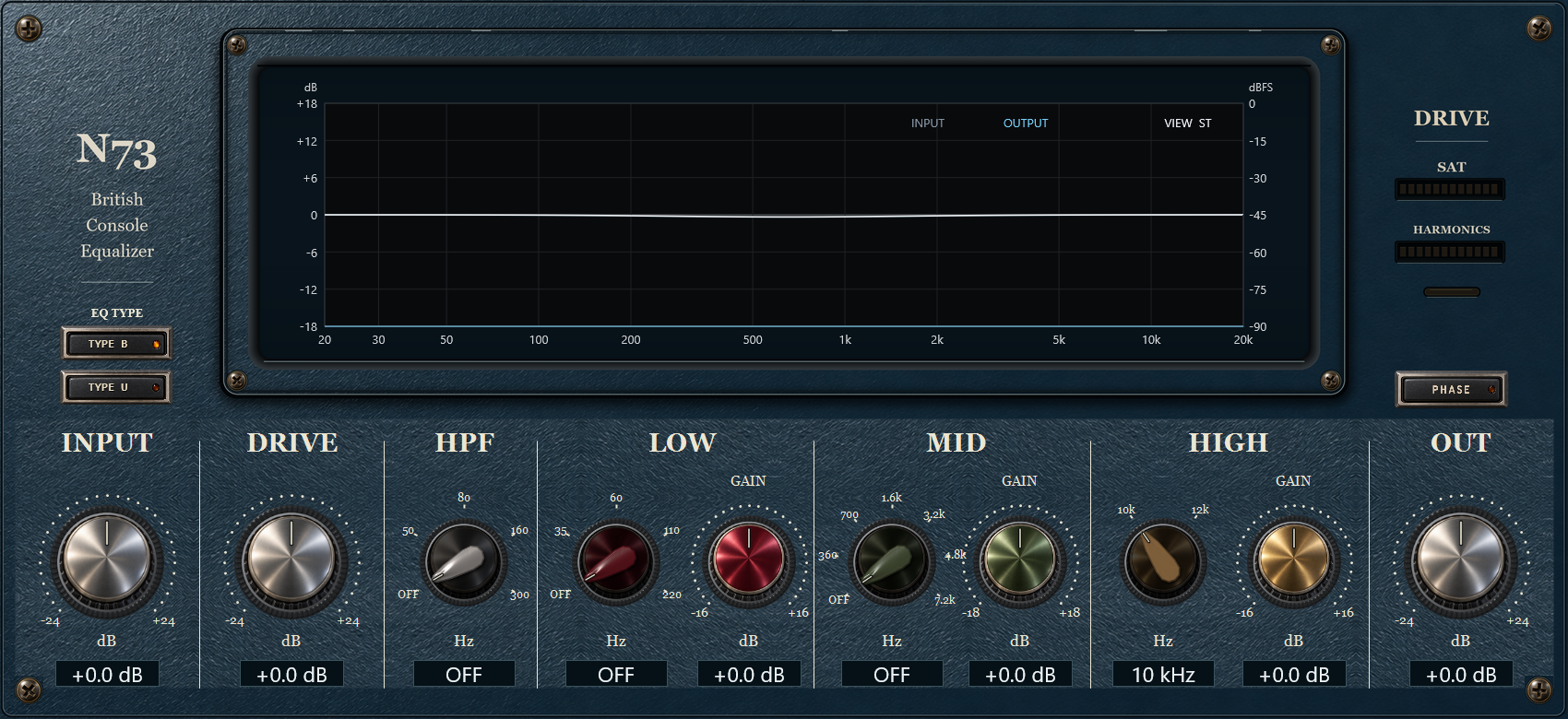
Insert [N73] PRISM EQ on a stereo track. Shape the sound with HPF and the EQ bands, adjust coloration with DRIVE, then match the listening level with OUT.
The interface
| Area | Controls and display |
|---|---|
| Header | Undo / Redo, PRESET, OS, A / B, RESET, Settings and POWER |
| Monitor | Input/output spectra and the EQ response curve. The model name and EQ TYPE are on the left; the DRIVE activity display is on the right. |
| Model panel | DRIVE, HPF, LOW, MID, HIGH and OUT. PHASE is above OUT. |
| Footer | License status (click it to open the licence screen), BUY during the trial, the central Classic Series signature and the PRIZLUNE product-page link. |
2. Installation
Requirements
- Windows (64-bit) and a 64-bit DAW that supports VST3
- A Prizlune account (free), and an internet connection when you start a trial or activate
Download
Download the ZIP from the product page at prizlune.com/products/n73/. The trial and the full version use the same installer, so buyers use this one too.
Installing
- Right-click the downloaded ZIP and choose "Extract All".
- Run
Install PRISM EQ - N73.exefrom the extracted folder. - If "Windows protected your PC" appears, click "More info" and then "Run anyway". The installer has no code signature, so this warning may appear.
- When asked "Do you want to allow this app to make changes to your device?", click "Yes". Writing to the shared VST3 folder requires administrator permission.
- Choose a language, accept the licence agreement and follow the instructions.
Installed to: C:\Program Files\Common Files\VST3\PRISM EQ - N73.vst3
Loading it in your DAW
Start your DAW and rescan plug-ins if needed. The plug-in appears as [N73] PRISM EQ (vendor: Prizlune).
Right after installation it is NOT ACTIVATED, and audio passes through unprocessed. Follow the next chapter to start a trial or activate the full version.
Updating
Run the installer of the new version in the same way to install over the old one. Your licence, presets and display settings are kept.
Uninstalling
Run Uninstall PRISM EQ - N73.exe from the ZIP, or remove it from Windows Settings > Apps. Your licence and presets are not deleted, so a reinstall works straight away.
3. Activation and Trial
To use PRISM EQ - N73, start a trial or activate the full version with your Prizlune account (free). Before that you can still change parameters, use presets and save projects, but audio passes through unprocessed.
Status
| Footer status | Meaning | Audio |
|---|---|---|
| NOT ACTIVATED | Neither a trial nor the full version is active | Passes through |
| ACTIVATING | Waiting for approval in your browser | As before |
| TRIAL · N DAYS LEFT | Trial running; N is the days left (1 DAY LEFT on the last day) | Processed |
| TRIAL ENDED | The trial period is over | Passes through |
| FULL | Full version | Processed |
Click the footer status to open the licence screen. While NOT ACTIVATED or TRIAL ENDED, a notice bar appears at the top of the product view.

Starting the trial (14 days)
- Click START TRIAL in the notice bar. My Prizlune opens in your browser.
- Sign in with your Prizlune account. If you don't have one, you can create it on that page.
- Check that the code in the browser matches the code in the plug-in, then click Start trial on this computer.
- When the footer shows TRIAL · 14 DAYS LEFT, you're done.
Each account can use the trial once per product, and each computer once as well. During the trial every feature works as in the full version.
Activating the full version
- Buy the product at prizlune.com. It is added to the Prizlune account you buy with.
- Click ACTIVATE in the plug-in (notice bar or licence screen).
- Sign in with the account you bought with, check the code and click Activate on this computer.
- When the footer shows FULL, you're done.
Waiting for approval
After START TRIAL or ACTIVATE, a waiting screen opens in the middle of the plug-in. It shows a large code in the form XXXX-XXXX and the time remaining. Approve the request in your browser within 10 minutes. Once approved, the licence is saved on this computer and takes effect immediately.
- REOPEN BROWSER: opens the approval page in your browser again.
- CANCEL (or Esc): stops the activation and returns to the previous state.
Licence screen
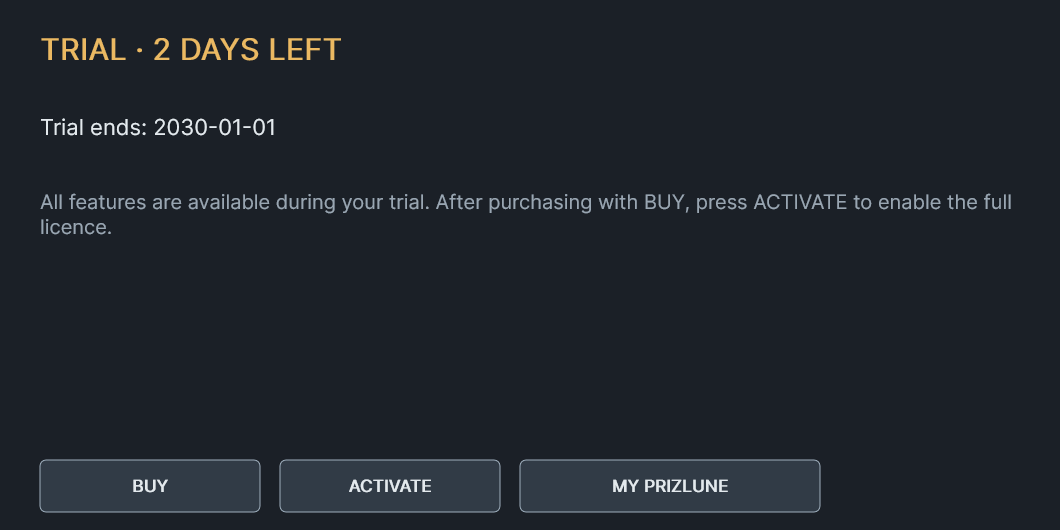
Open it from the footer status or from License at the bottom left of Settings. Close it with the × at the top right or Esc.
- Trial: shows the end date. BUY opens the purchase page; after buying, ACTIVATE switches to the full version. MY PRIZLUNE opens the member page.
- Full: shows the registered email, this computer's name and the activation date. RELOAD LICENSE reads the saved licence again.
Buying during the trial, and when it ends

When the trial ends, the TRIAL ENDED notice bar appears and audio passes through. Your settings and projects are kept. Buy with BUY and activate with ACTIVATE to keep using it.
Several computers and offline use
- License activation connects when you press START TRIAL or ACTIVATE. Activated products work offline. Optional update checks can be disabled in Settings.
- As long as you use your own account, there is no limit to the number of computers. On a new computer or after reinstalling Windows, press ACTIVATE there. You don't need to deactivate the old one.
- You can see your products and activated computers on My Prizlune (account.prizlune.com).
4. Controls and basic operation
| Control | Range and purpose |
|---|---|
| INPUT | -24 to +24 dB. Adjusts input level before DRIVE. At 0 dB, existing sound is preserved. |
| DRIVE | -24 to +24 dB. Adjusts the level before the EQ and the coloration of the LINE stage. |
| HPF | OFF / 50 / 80 / 160 / 300 Hz. Attenuates low frequencies. |
| LOW | OFF / 35 / 60 / 110 / 220 Hz. Low shelving band; GAIN is -16 to +16 dB. |
| MID | OFF / 360 / 700 Hz / 1.6 / 3.2 / 4.8 / 7.2 kHz. Midrange bell; GAIN is -18 to +18 dB. |
| HIGH | 10 / 12 kHz. High shelving band; GAIN is -16 to +16 dB. |
| OUT | -24 to +24 dB. Adjusts the level after the EQ, including compensation for a level increase from DRIVE. |
| PHASE | ON reverses the polarity of both processed channels. OFF restores normal polarity. |
OFF on HPF, LOW or MID removes that filter or band. HIGH has no OFF position; return its GAIN to 0 dB to remove the boost or cut. Frequency labels are selector reference values. The combined analog-style response differs from a simple ideal filter.
Mouse operation
| Action | Result |
|---|---|
| Vertical drag | Changes the value. Frequency selectors move in discrete steps. |
| Mouse wheel | Changes the control value. |
| Double-click | Restores that control to its default value. |
Default settings
INPUT, DRIVE, OUT and all GAIN controls are at 0 dB. HPF, LOW and MID are OFF; HIGH is at 10 kHz. EQ TYPE is TYPE B, PHASE is OFF, OS is 1x and POWER is ON. RESET restores the selected A/B bank to its defaults.
5. EQ TYPE: two EQ responses
Use TYPE B / TYPE U beneath the model name to select the response of the HPF and three EQ bands. At the same frequency and GAIN settings, the bandwidth, shelf shape and combined-band response can differ. The displayed EQ curve follows the selected type.
| Type | Response |
|---|---|
| TYPE B | The original N73 EQ response. This is the default and the type used when loading earlier settings. |
| TYPE U | A response tuned using another 1073-style EQ as a reference. Its midrange width and the response when LOW and HIGH are used together differ from TYPE B. |
Shared DRIVE character
EQ TYPE changes the EQ section. DRIVE / LINE coloration, OUT, PHASE and OS have the same roles in both types. Keep DRIVE and the EQ settings fixed while switching to compare the EQ responses. Match the listening level with OUT.
Saving and switching
EQ TYPE is stored separately in each A/B bank and saved in presets and DAW projects. Earlier projects and presets without EQ TYPE load as TYPE B. RESET also restores TYPE B. The header's A / B selects a settings bank; TYPE B / TYPE U selects an EQ response.
Click a metal-framed type button to switch. A depressed cap and amber lamp indicate the selected type. When EQ TYPE has focus, the left and right arrow keys select the type. EQ Type also supports DAW automation. Switching during playback uses a short crossfade.
Frequency and GAIN markings
Markings are control reference values. They do not guarantee a measured peak value or gain at a particular frequency. TYPE U's upper LOW endpoint corresponds to the reference response's maximum setting. HIGH at 10 kHz is an N73 extension derived by shifting TYPE U's 12 kHz response in frequency.
6. DRIVE, monitoring and overall adjustment
Using DRIVE and OUT
The signal path is Input → INPUT → DRIVE → LINE coloration → EQ → OUT → PHASE → Output. DRIVE changes the input level and LINE-stage behavior. Even and odd harmonics and saturation vary with the frequency content and strength of the incoming signal.
After increasing DRIVE, lower OUT to match the listening level before comparing. Also use OUT to compensate for an increase from EQ boosts. Check the output level on your DAW meters.
Reading the monitor
The input/output spectra show the frequency content of the signal; the curve indicates the EQ response. The graph is display-only. The SAT / HARMONICS display and warm light on the right indicate coloration in relation to DRIVE and the input signal. They are not precision distortion meters.
PHASE: output polarity
PHASE, above OUT, reverses the polarity of both channels after processing. Use it to compare polarity when combining multiple microphones or parallel paths. It does not adjust frequency-dependent phase or timing. It reverses the already colored signal, rather than reversing the input before the LINE stage.
OS: oversampling
Choose 1x / 2x / 4x / 8x from OS in the header. This sets oversampling for the LINE stage. Higher settings increase CPU usage. Reported latency is 32 samples at every setting, approximately 0.67 ms at 48 kHz. Check your DAW latency compensation as well.
Comparing with POWER
Turning POWER OFF bypasses LINE, EQ, INPUT, DRIVE, OUT and PHASE, switching to latency-aligned dry audio. It follows host bypass, with a short crossfade during switching.
7. Comparison, history and presets
A/B and Undo / Redo
A / B provides two setting banks for comparison. Edit the selected bank and switch to the other to compare. PHASE and EQ TYPE are stored per bank. RESET restores the selected bank to its defaults.
Undo / Redo at the upper left steps backward or forward through N73 edits. One continuous knob drag is one edit. This history is separate from DAW Undo. Searches and preset-note edits are not included in the sound-edit history.
Loading a preset
- Press PRESET to open the central browser.
- Filter the list with Factory / User, categories or search.
- Select a preset to load it into the currently selected A/B bank.
Saving your settings
Choose Save New, enter a name and category, then save. Sound settings include PHASE and EQ TYPE. Choose an existing category or create one. User presets can be renamed or deleted; Factory originals are not changed. Notes and favorites are saved for the user. Canceling changes neither the sound nor the saved file.
Names and project recall
After loading or saving, the name and User/Factory origin are displayed. Editing changes the name to Custom; returning to the loaded settings restores that name. Default denotes the published defaults. Temporary switches such as POWER are not included in presets.
Preset-name provenance is remembered within the current editor session. Reopening a project restores sound settings, while the displayed name returns to Custom or Default. Save a DAW project or a preset according to what you need to recall.
8. Settings
Settings and interface size
In Settings → Display, choose a UI Scale from 50% to 200%. Only a scale accepted by the DAW is saved and reused when the editor next opens. This is an N73 interface setting, stored separately from sound presets.
Switch directly between PRESET and Settings from the header. Click the same button again, use Close or press Escape to return to the model panel.
Settings → Language sets the language of Settings, the licence screen and notices: Automatic / English / 日本語. Automatic follows the Windows display language. License at the bottom left opens the licence screen.
9. Usage questions and specifications
| Symptom | What to check |
|---|---|
| Not listed in the DAW | Use a Windows x64 DAW supporting VST3. Restart it and rescan plug-ins. |
| No audible change | Check POWER, the OFF positions of HPF / LOW / MID, GAIN values and license status. |
| A previous preset name is missing | Project recall displays Custom or Default. Sound settings are restored from the project state. |
| Wrong interface size | Choose a scale in Settings. A scale rejected by the DAW is not saved. |
| Update/removal fails | Close every DAW or other host that has N73 loaded, then try again. |
Specifications
| Item | Details |
|---|---|
| Format | Windows x64 / VST3. Requires a compatible stereo DAW. |
| Processing | HPF, LOW shelf, MID bell, HIGH shelf, LINE input-stage character, DRIVE, OUT and PHASE. |
| OS / latency | 1x / 2x / 4x / 8x. Reported latency is 32 samples at every setting. |
| Compare and save | A/B, Undo / Redo, RESET, Factory / User presets and DAW project recall. |
When contacting support, include your OS, DAW, sample rate, reproduction steps and displayed license state. The PRIZLUNE logo in the footer opens this product’s page.
The sidebar separates Display, Language and Updates. Headings, descriptions and buttons follow the selected language; Automatic uses the operating system display language. When you open License from Settings and close it with ×, you return to the same interactive settings page.
10. Updates and the product page
Released editions include update checks. When you open the editor, the plug-in checks the public download in the background, approximately once per day. You do not need to sign in again to check for updates.
Update notification
When a newer publication is available, UPDATE appears near the version in the footer. Click it to open this product's page. Read the release information and download the update. Close your DAW before installing the downloaded update.
Settings → Updates
| Control | Action |
|---|---|
| Automatic | ON by default. Turn it OFF to disable automatic requests. This is remembered as a product preference, separate from sound settings. |
| Check now | Checks immediately, including when automatic checks are OFF. |
| Product page | Opens this product's page after public information has been received. The PRIZLUNE logo at the bottom right also opens the product page at any time. |
Working offline
If the check cannot retrieve information, check your connection and try manually later. A failed update check does not stop audio or project saving. The product continues its normal behavior for its license state; activated products work offline.
Update checks are independent of audio processing. Changing automatic checks or using a notification does not alter your sound or the parameters stored in a DAW project.
11. Troubleshooting
| Problem or message | What to do |
|---|---|
| The plug-in doesn't appear in my DAW | Rescan plug-ins in your DAW. Check that C:\Program Files\Common Files\VST3 is included in the scan and that the DAW is 64-bit. |
| The sound doesn't change | While the footer shows NOT ACTIVATED or TRIAL ENDED, audio passes through. Start a trial or activate the full version. Also check that POWER in the header is ON. |
| Could not open your browser | Press REOPEN BROWSER on the waiting screen. Also check that Windows has a default browser. |
| Not approved | The request was cancelled in the browser, or the account has no purchase of this product. Make sure you are signed in with the account you bought with, then press ACTIVATE again. |
| The request expired | It was not approved within 10 minutes. Press ACTIVATE or START TRIAL again. |
| This account or computer has already used the trial | The trial can be used once per product, per account and per computer. Buy with BUY, or press ACTIVATE if you already own it. |
| Could not save the licence | Check free disk space and that you can write to your user folder, then try again. |
| Activation failed | Check your internet connection and any security software or firewall settings, then try again. |
| I bought it but it doesn't show FULL | Check that you are signed in with the account you bought with and that the product appears on My Prizlune, then press ACTIVATE. If you bought with another email address, add that address in My Prizlune's account management and the product will appear. |
If this doesn't solve it, contact us at prizlune.com/contact/. Common questions are answered at prizlune.com/faq/.