PRISM Comp - FC67 User Manual
1. Getting started with FC67
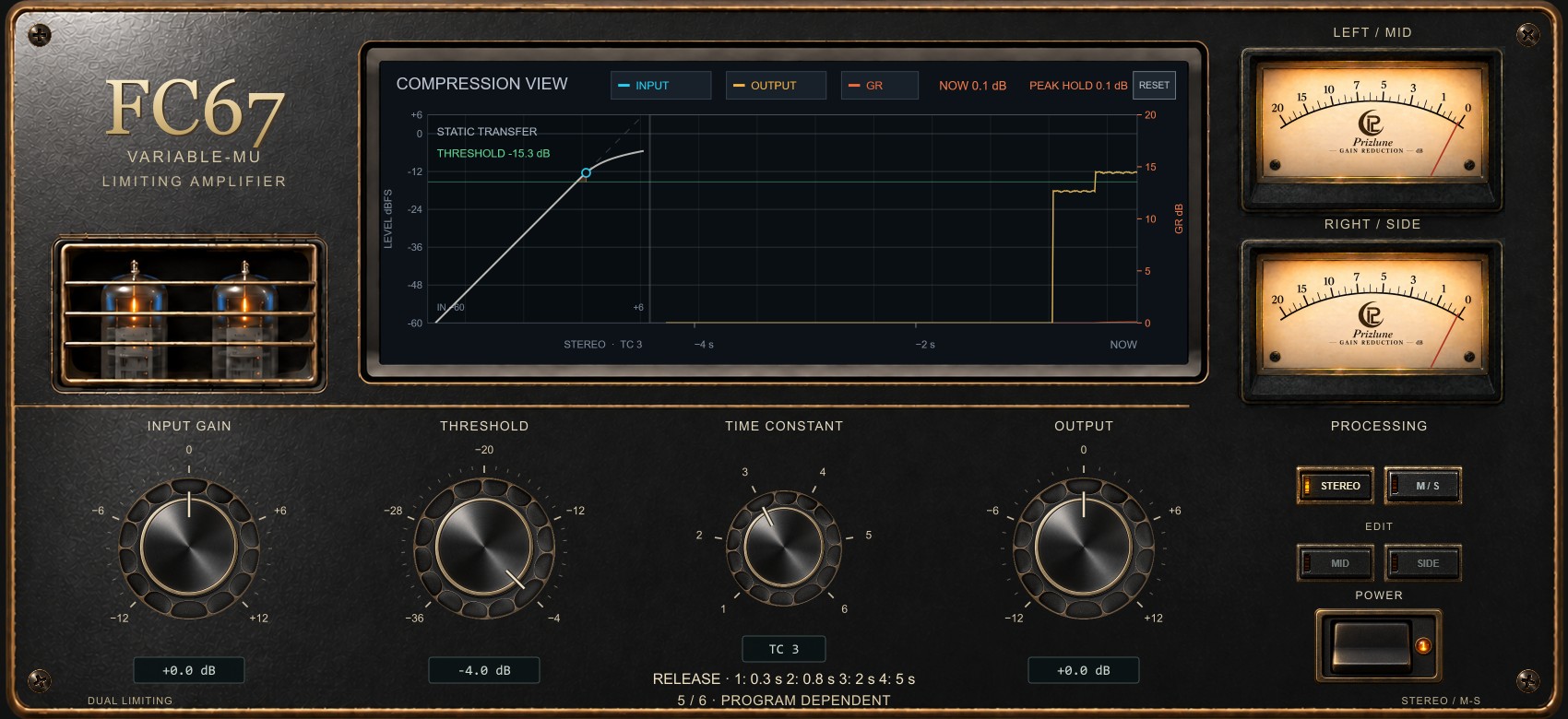
FC67 is a variable-mu-style compressor. It offers linked stereo compression and independent processing for the center (MID) and the difference between the left and right channels (SIDE).
Quick start
- Insert [FC67] PRISM Comp on an audio track or bus.
- Activate the trial or full version.
- Start with STEREO, POWER ON and MIX at 100%.
- Play audio and adjust INPUT GAIN and THRESHOLD while watching GR on the VU meters or compression view.
- Choose a TIME CONSTANT and match the level with OUTPUT before comparing with POWER.
2. Installation
Requirements
- Windows (64-bit) and a 64-bit DAW that supports VST3
- A Prizlune account (free), and an internet connection when you start a trial or activate
Download
Download the ZIP from the product page at prizlune.com/products/fc67/. The trial and the full version use the same installer, so buyers use this one too.
Installing
- Right-click the downloaded ZIP and choose "Extract All".
- Run
Install PRISM Comp - FC67.exefrom the extracted folder. - If "Windows protected your PC" appears, click "More info" and then "Run anyway". The installer has no code signature, so this warning may appear.
- When asked "Do you want to allow this app to make changes to your device?", click "Yes". Writing to the shared VST3 folder requires administrator permission.
- Choose a language, accept the licence agreement and follow the instructions.
Installed to: C:\Program Files\Common Files\VST3\PRISM Comp - FC67.vst3
Loading it in your DAW
Start your DAW and rescan plug-ins if needed. The plug-in appears as [FC67] PRISM Comp (vendor: Prizlune).
Right after installation it is NOT ACTIVATED, and audio passes through unprocessed. Follow the next chapter to start a trial or activate the full version.
Updating
Run the installer of the new version in the same way to install over the old one. Your licence, presets and display settings are kept.
Uninstalling
Run Uninstall PRISM Comp - FC67.exe from the ZIP, or remove it from Windows Settings > Apps. Your licence and presets are not deleted, so a reinstall works straight away.
3. Activation and Trial
To use PRISM Comp - FC67, start a trial or activate the full version with your Prizlune account (free). Before that you can still change parameters, use presets and save projects, but audio passes through unprocessed.
Status
| Footer status | Meaning | Audio |
|---|---|---|
| NOT ACTIVATED | Neither a trial nor the full version is active | Passes through |
| ACTIVATING | Waiting for approval in your browser | As before |
| TRIAL · N DAYS LEFT | Trial running; N is the days left (1 DAY LEFT on the last day) | Processed |
| TRIAL ENDED | The trial period is over | Passes through |
| FULL | Full version | Processed |
Click the footer status to open the licence screen. While NOT ACTIVATED or TRIAL ENDED, a notice bar appears at the top of the product view.

Starting the trial (14 days)
- Click START TRIAL in the notice bar. My Prizlune opens in your browser.
- Sign in with your Prizlune account. If you don't have one, you can create it on that page.
- Check that the code in the browser matches the code in the plug-in, then click Start trial on this computer.
- When the footer shows TRIAL · 14 DAYS LEFT, you're done.
Each account can use the trial once per product, and each computer once as well. During the trial every feature works as in the full version.
Activating the full version
- Buy the product at prizlune.com. It is added to the Prizlune account you buy with.
- Click ACTIVATE in the plug-in (notice bar or licence screen).
- Sign in with the account you bought with, check the code and click Activate on this computer.
- When the footer shows FULL, you're done.
Waiting for approval
After START TRIAL or ACTIVATE, a waiting screen opens in the middle of the plug-in. It shows a large code in the form XXXX-XXXX and the time remaining. Approve the request in your browser within 10 minutes. Once approved, the licence is saved on this computer and takes effect immediately.
- REOPEN BROWSER: opens the approval page in your browser again.
- CANCEL (or Esc): stops the activation and returns to the previous state.
Licence screen
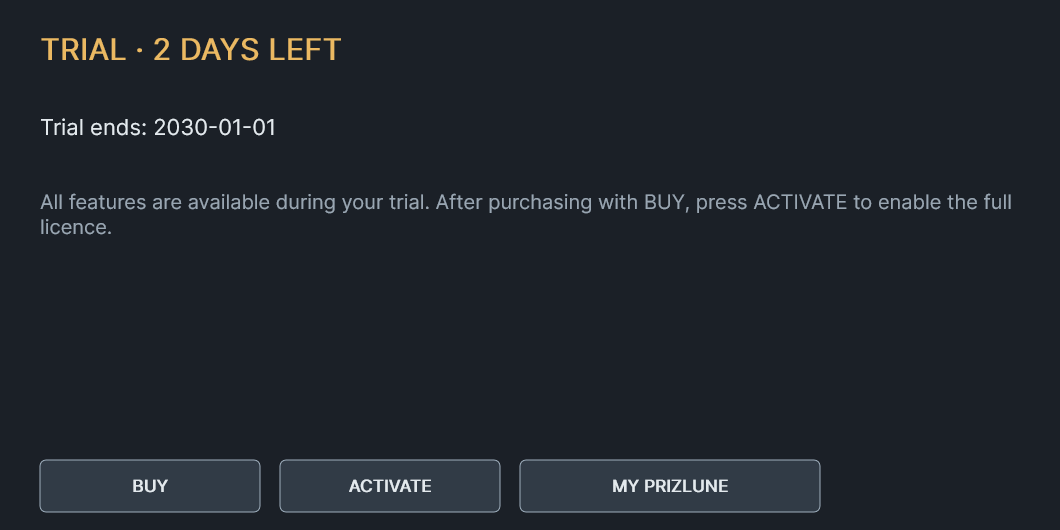
Open it from the footer status or from License at the bottom left of Settings. Close it with the × at the top right or Esc.
- Trial: shows the end date. BUY opens the purchase page; after buying, ACTIVATE switches to the full version. MY PRIZLUNE opens the member page.
- Full: shows the registered email, this computer's name and the activation date. RELOAD LICENSE reads the saved licence again.
Buying during the trial, and when it ends

When the trial ends, the TRIAL ENDED notice bar appears and audio passes through. Your settings and projects are kept. Buy with BUY and activate with ACTIVATE to keep using it.
Several computers and offline use
- License activation connects when you press START TRIAL or ACTIVATE. Activated products work offline. Optional update checks can be disabled in Settings.
- As long as you use your own account, there is no limit to the number of computers. On a new computer or after reinstalling Windows, press ACTIVATE there. You don't need to deactivate the old one.
- You can see your products and activated computers on My Prizlune (account.prizlune.com).
4. Sound controls
| Control | What it does |
|---|---|
| INPUT GAIN | -12 to +12 dB before compression. Higher settings typically produce more compression and change the coloration. |
| THRESHOLD | -36 to -4 dB. Lower settings let quieter signals engage compression. |
| TIME CONSTANT | TC 1 through TC 6 select combinations of attack and recovery. |
| OUTPUT | -12 to +12 dB on the processed path. Match the loudness of the bypassed signal for a useful comparison. |
| MIX | 0% is the original signal and 100% is the processed signal. Intermediate settings blend the two. |
| POWER | Use the header or panel switch. OFF passes audio through, returns the GR meters to zero and darkens the compression view. |
Choosing a time constant
The panel lists approximate releases of 0.3, 0.8, 2 and 5 seconds for TC 1 through TC 4. The recovery of TC 5 and TC 6 depends on the preceding signal. Listen to the bass and the tails of notes when choosing a setting.
Editing the controls
Drag knobs vertically, or hold Shift for fine adjustment. Use the wheel or arrow keys with a selected knob. Double-click to restore its default. Drag the MIX slider horizontally.
5. STEREO and MID / SIDE
STEREO links compression across the left and right channels. Both VU meters show the same gain reduction. Start here for tracks or buses where you want to keep the stereo image stable.
M / S processes MID and SIDE independently. Click MID or SIDE to choose which controls to edit. Both paths continue to process audio. The upper VU meter shows MID gain reduction and the lower one shows SIDE gain reduction.
| Edit target | What to listen for |
|---|---|
| MID | Listen for changes to centered sounds such as vocals, kick and bass. Pay attention to how the compressor recovers after low notes. |
| SIDE | Listen to room sound and stereo width. Check in mono after changing the balance with OUTPUT. |
STEREO, MID and SIDE each retain their own INPUT GAIN, THRESHOLD, TIME CONSTANT and OUTPUT. The curve and GR history follow the edit target. The input and output traces show the reconstructed left and right signals.
6. Reading the compression view
| Display | Meaning |
|---|---|
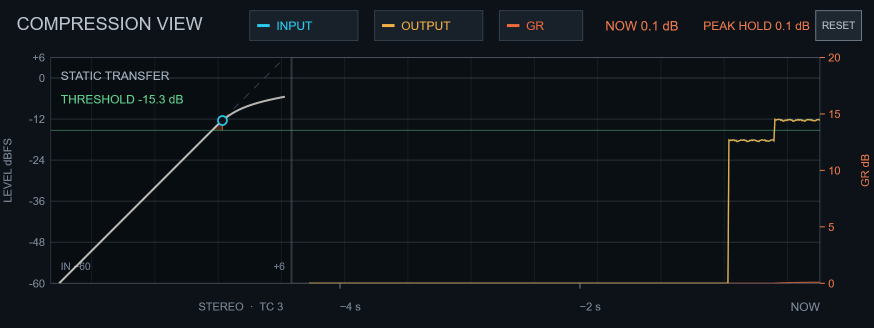
| INPUT / OUTPUT | Cyan shows the signal after INPUT GAIN. Yellow shows the actual output, including OUTPUT, MIX and DELTA. Read these on the left axis. |
| GR | Gain reduction for the selected path. The right scale runs from 0 dB at the bottom to 20 dB at the top. Values above 20 dB still appear in the numeric readouts. |
| NOW / PEAK HOLD | NOW shows current GR. PEAK HOLD retains the highest value. The small RESET beside it restarts the hold at NOW. |
The curve uses -60 to +6 dBFS on both axes. The dotted diagonal is the 1:1 reference, the green line is THRESHOLD, and the cyan circle follows the selected path's input. The shaded area is bounded by the threshold, curve and a vertical line from the circle. INPUT GAIN changes the input display. OUTPUT and MIX change the actual output trace. The static curve stays fixed.
The curve's THRESHOLD is the effective threshold calculated from the knob setting and TIME CONSTANT. The green line marks the center of the compression knee, so its value can differ from the knob readout.
History runs from past at left to NOW at right. Click INPUT, OUTPUT or GR in the legend to toggle its trace. FC67 remembers your choices. The GR readouts remain available when the GR trace is hidden.
7. Compare, save and configure
A/B, RESET and Undo
Each A/B bank stores 12 sound parameters. The PROCESSING selection, MIX, POWER and DELTA are shared. RESET in the header restores the active bank and sets MIX to 100%. Undo and Redo step through edits made in the plug-in. RESET in the compression view affects the GR hold only.
Presets and projects
Use PRESET to open the browser and select a Factory or User preset, or save the current sound under a name. A preset stores the active bank's sound and MIX. Your DAW project stores both banks and the shared parameters.
MIX and DELTA
Try stronger compression at 100% MIX, then lower MIX to blend back the original transients. DELTA lets you hear the portion removed by compression. DELTA is silent at 0% MIX.
Settings
Use Display to set the editor size and Language to select the interface language. Automatic follows the Windows display language. Click the PRIZLUNE logo to open the product page.
8. Updates and the product page
Released editions include update checks. When you open the editor, the plug-in checks the public download in the background, approximately once per day. You do not need to sign in again to check for updates.
Update notification
When a newer publication is available, UPDATE appears near the version in the footer. Click it to open this product's page. Read the release information and download the update. Close your DAW before installing the downloaded update.
Settings → Updates
| Control | Action |
|---|---|
| Automatic | ON by default. Turn it OFF to disable automatic requests. This is remembered as a product preference, separate from sound settings. |
| Check now | Checks immediately, including when automatic checks are OFF. |
| Product page | Opens this product's page after public information has been received. The PRIZLUNE logo at the bottom right also opens the product page at any time. |
Working offline
If the check cannot retrieve information, check your connection and try manually later. A failed update check does not stop audio or project saving. The product continues its normal behavior for its license state; activated products work offline.
Update checks are independent of audio processing. Changing automatic checks or using a notification does not alter your sound or the parameters stored in a DAW project.
9. Troubleshooting
| Symptom | What to check |
|---|---|
| FC67 is missing in the DAW | Check Windows x64 VST3 support and the installed VST3 location. Then rescan plug-ins in the DAW. |
| No gain reduction | Check POWER and activation. Make sure the selected MID or SIDE path has signal, then adjust INPUT GAIN or THRESHOLD. |
| Output is too loud | Lower OUTPUT or INPUT GAIN and check the DAW peak meter. |
| PEAK HOLD exceeds the visible history | The hold lasts longer than the visible history. Press RESET beside PEAK HOLD when you want to start a new reading. |
| The installer cannot replace FC67 | Close the DAW using FC67, then run the installer again. |
When contacting support, include the DAW, sample rate, controls involved and steps to reproduce the problem. Visit prizlune.com/products/fc67/.